
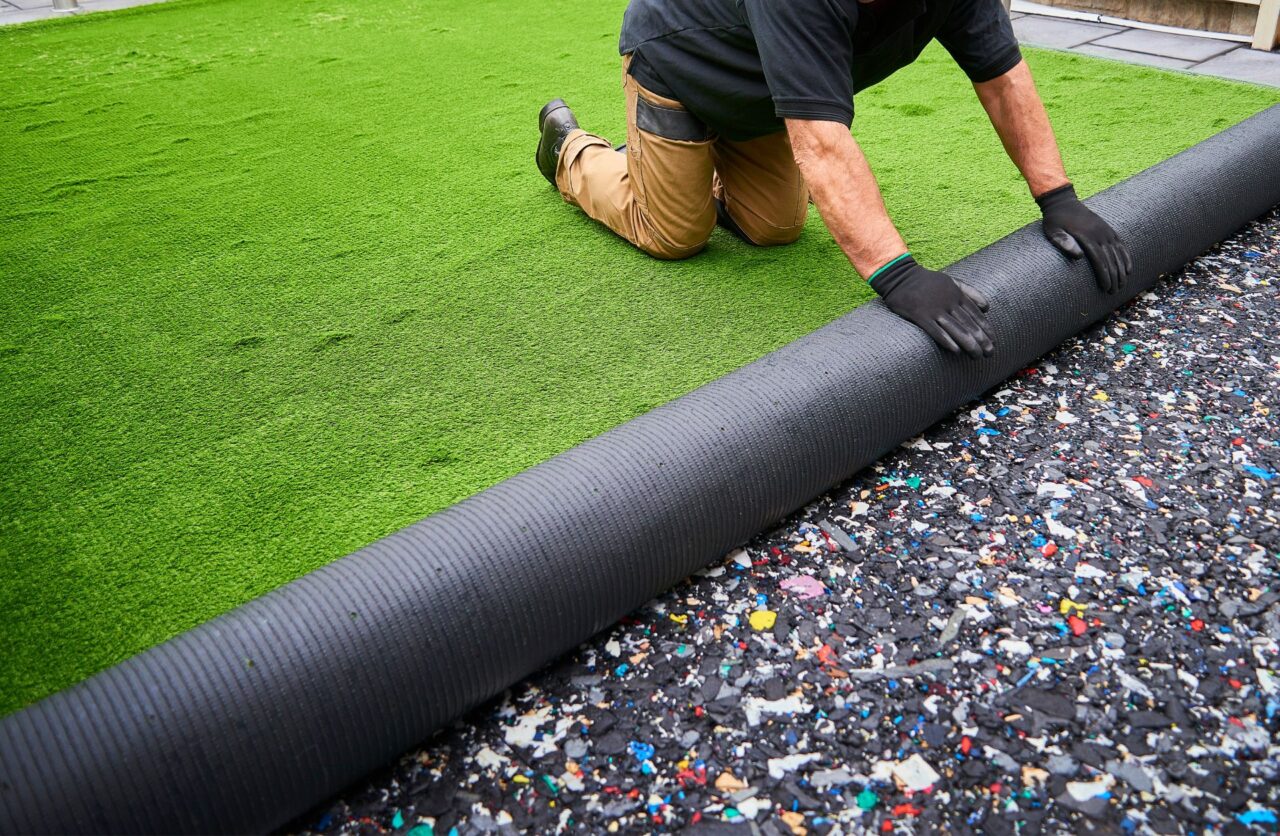
What goes under artificial grass is the part nobody sees and the part that decides whether your lawn lasts. In Toronto, a proper install is really several layers: excavated soil, a compacted crushed stone base, a weed barrier, the turf, and infill on top. Get those layers right and the surface stays flat and draining for two decades. Get them wrong and it ripples, puddles, and heaves the first winter. This is how the base and installation process actually works on GTA properties, and why Toronto Turf Pros spends most of the job below the grass, not on it.
What goes under artificial grass?
Under artificial grass sits a built-up sub-base, usually 75 to 100 millimetres of compacted crushed stone over excavated and graded soil, topped with a weed barrier before the turf is laid and infilled. The turf itself is the thin part. Everything under it exists to do three jobs: drain water away, resist frost heave, and give the fibres a firm, level surface so the lawn does not settle into dips. In the GTA, the depth and makeup of that base changes with your soil, which is why a cookie-cutter spec does not work across the region.
Step one: excavation and grading
The crew starts by removing the existing sod and digging down enough to fit the new base without raising the lawn above your patio or walkways. They grade the sub-soil to create a gentle slope that carries water toward a drainage point, away from the house. This step matters more on the flat clay lots common in Brampton, Markham, and Vaughan, where water has nowhere natural to go, and around older Toronto homes where the yard may already pitch toward the foundation. Good grading here prevents the puddling that ruins a cheap install.
Step two: the crushed stone base
Next comes the aggregate. A typical GTA build uses a granular base of crushed stone, sometimes with a coarser layer below and a finer stone dust or high-performance aggregate on top for a smooth screed. Each layer is compacted with a plate compactor in passes, because loosely dumped stone will settle and leave lumps. The base has to be firm enough to walk on without leaving footprints. On heavy clay, crews often build a deeper, more open base so meltwater and rain can move sideways through the stone rather than sitting on the clay below.
Step three: drainage and freeze-thaw
Drainage is engineered into the base, not added later. Because the aggregate is free-draining and graded to slope, water passes through the turf backing and the stone and exits at a low point. This is what lets a Toronto lawn shrug off spring melt and summer storms. It also protects against freeze-thaw, the repeated freezing and thawing that defines GTA shoulder seasons. A well-drained base holds far less water, so there is less to expand and lift the surface when temperatures swing around zero in March. A soggy base, by contrast, heaves and leaves the lawn uneven.
On the flattest clay lots, where surface water has nowhere to go, the crew may add a perforated drain line or a pop-up emitter tied into the base so heavy rain has a clear exit. That extra step is common on new-build yards in Brampton and north Markham, and it is planned during the same site visit that scopes a backyard turf install.
Step four: weed barrier, turf, and seams
A geotextile weed barrier goes over the compacted base to stop growth from pushing up through the lawn. The turf is then rolled out, left to relax so it lies flat, and cut to the exact shape of the yard. Where two pieces meet, the installer joins them with seaming tape and adhesive, matching the blade direction so the seam disappears. The whole perimeter is fastened with galvanized nails or a fixed edge so nothing lifts. Careful cutting around trees, beds, and the tight corners of a downtown lot is what separates a clean job from an obvious one.
Step five: infill and finishing
Infill is brushed into the fibres last. This is sand or a specialty granule that weighs the turf down, keeps the blades standing upright, and protects the backing. It also helps with drainage and, in pet or high-traffic areas, with odour and durability. The crew power-brushes the lawn to lift the fibres and settle the infill evenly, then cleans the site. The same layered approach applies whether it is a lawn or a low-pile putting green, though a green uses a firmer base and finer infill for a true ball roll.
Frequently asked questions
How deep should the base be under artificial grass in Toronto?
Usually 75 to 100 millimetres of compacted crushed stone, and often deeper over the heavy clay found in the northern GTA. The exact depth depends on soil and drainage, which is why an on-site assessment matters.
Do you need a weed barrier under turf?
Yes. A geotextile barrier over the base stops weeds from growing up through the turf and helps separate the aggregate from the soil below, keeping the base stable.
Can artificial grass go over concrete or an existing patio?
Yes, with a slightly different build. Over a hard surface the crew ensures drainage and often adds a shock pad or thin base layer, rather than the full stone sub-base used on soil.
Ask about your site prep in the GTA
The base is where a lawn is won or lost, so it is worth doing right. Call (647) 559-1722 or book a site assessment and our GTA crew will check your soil and drainage and spec the correct base for your yard.