
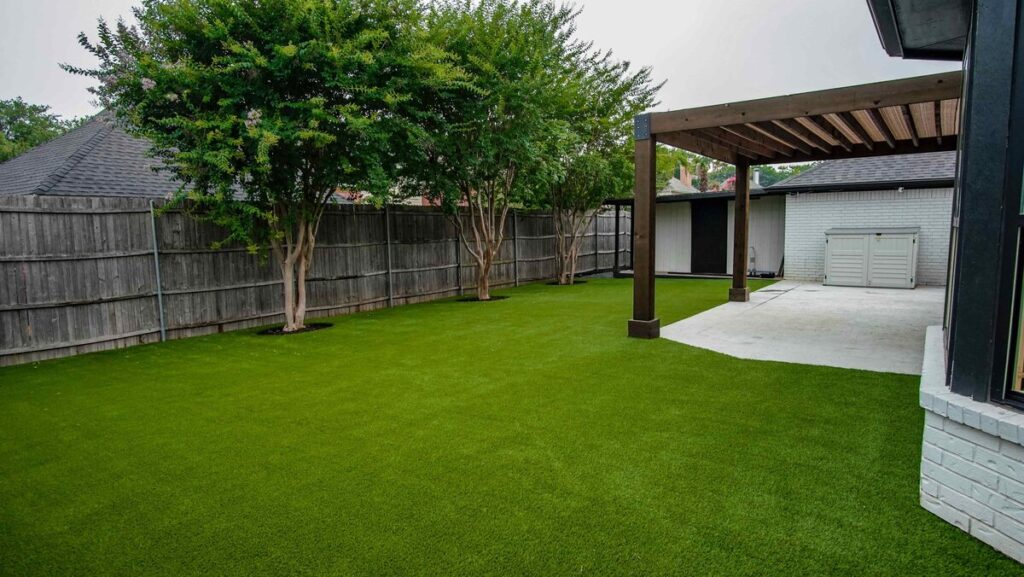
Does artificial grass survive Ontario winters? Yes, comfortably. Quality turf is built to handle snow, frost, and the freeze-thaw cycles that hammer Toronto lawns from November to April, and it comes through spring looking exactly as it did in the fall. Real grass goes brown and dormant under snow cover, while artificial grass stays green and structurally sound. This is how turf handles a GTA winter, what freeze-thaw does to it, and how to care for it in the cold. Our GTA crew installs with these winters specifically in mind.
Does artificial grass survive Ontario winters?
Yes. Artificial grass is engineered to withstand the full Ontario weather range, from summer heat waves to deep winter cold well below zero. The fibres and backing stay flexible and do not crack in the cold, and the turf is UV-stabilized so years of sun and frost do not fade or brittle it. Toronto averages well over a metre of snow across a season, with lake-effect bands coming off Lake Ontario, and turf handles all of it. It simply sits under the snow and reappears green when the melt comes, with none of the winterkill or bare patches a natural lawn suffers.
How does turf handle snow?
Snow does not hurt artificial grass. You can leave it to melt naturally, and because the base underneath drains freely, the meltwater passes straight through instead of pooling. Light snow can be left alone entirely. For deeper accumulation you want to clear, a plastic shovel or a broom works well, and it is best to leave a thin layer rather than scraping down to the fibres. The key with a GTA winter is that the turf never turns to the mud pit a real lawn becomes during a January thaw, so the yard stays usable on milder days.
Frost, freeze-thaw, and the base
Frost forms on turf just as it does on any surface, giving the blades a white, crisp coating on a cold Toronto morning. That is harmless and disappears as the sun warms the yard. The real winter test is freeze-thaw, the repeated cycle of freezing and thawing that defines GTA shoulder seasons in late fall and early spring. This is where the base earns its keep. A properly built, free-draining crushed stone base holds little water, so there is little to expand and lift the lawn as temperatures cross zero. On the heavy clay of Markham, Brampton, and Vaughan, that drainage is what keeps a turf lawn flat while nearby natural lawns and even patios heave.
Walking on frozen turf
Turf is safe to walk on when frozen, but the blades are stiffer in deep cold, so it is best to avoid heavy dragging or dropping sharp objects on a hard-frozen surface. Foot traffic is fine. If frost has coated the lawn, let it thaw rather than trying to sweep ice crystals off the frozen fibres. For most Toronto households the yard carries on through winter as a clean, firm surface, which is a big part of why families with kids and dogs choose it over a lawn that spends four months as frozen mud.
Road salt and ice melt
Salt and de-icers do not damage quality artificial grass, which is useful near GTA driveways and walkways where road salt gets tracked around. Where you can, a rinse in early spring clears any salt residue and grit off the surface so the lawn looks fresh for the season. Around a pool surround or a walkway that sees winter traffic, that quick spring cleanup is usually all the maintenance the turf needs after the snow is gone.
What about ice and ice storms?
Freezing rain coats everything in the GTA a few times each winter, and turf handles it the same way it handles frost. Let the ice melt and drain through rather than chipping at it, which can catch the fibres. There is no need to salt the lawn, and you should never use a metal shovel or a snow blower on it. When the January thaw arrives the ice releases and the surface is ready to use, unlike the soft, rutted mess a natural lawn becomes in the same conditions.
Spring recovery
When the snow finally clears, artificial grass needs almost nothing to bounce back. Rake or blow off the leaves and grit that collected over winter, give matted high-traffic lanes a brush to lift the fibres, and rinse the surface. That is the whole spring routine. There is no reseeding, no bare-patch repair, and no waiting weeks for a natural lawn to green up. The same durability that carries a backyard lawn through winter means it is ready to use the moment the weather turns.
Frequently asked questions
Can you shovel snow off artificial grass?
Yes. Use a plastic shovel or a broom and leave a thin layer rather than scraping to the base. Light snow can simply be left to melt and drain through on its own.
Does freeze-thaw damage artificial grass in Toronto?
Not when the base is built correctly. A free-draining crushed stone base holds little water, so freeze-thaw has little to lift, and the lawn stays flat through the GTA shoulder seasons.
Does artificial grass get slippery in winter?
It can develop a light frost or thin ice like any outdoor surface, but the textured fibres give better grip than smooth concrete or interlock, and it drains rather than holding a sheet of water.
Get a winter-ready lawn in the GTA
A lawn that looks green in every season starts with the right base. Call (647) 559-1722 or request a free estimate and our GTA team will build a turf lawn that shrugs off Ontario winters.